
When I was young, like many kids of the 1980s and 90s, I loved WWF (now WWE) wrestling. That era is considered the Golden Age of wrestling. Characters like Randy “Macho Man” Savage, Rowdy Roddy Piper, the Undertaker, and the Ultimate Warrior were larger than life, and they represented everything I wanted to do and be: strong, aggressive, boisterous, and brash. There was no character bigger, though, than the immortal Hulk Hogan. Every time Hogan’s theme music, “Real American,” erupted, so did I. The lyrics, like the music itself, rocked both the show house and my house. It was patriotic pageantry being pumped through my television straight into my veins—and I was addicted.
“When it comes crashing down and it hurts inside/ You gotta take a stand/it don’t help to hide./ If you hurt my friends, then you hurt my pride/ I gotta be a man/ I can’t let it slide.”
“I am a real American/ Fight for the rights of every man/ I am a real American/ Fight for what’s right/ Fight for your life!”
I don’t watch wrestling anymore, but whenever I hear that 80s-era rock ballad, I still beam with nostalgia. It still makes me feel young and boisterous; it still makes me feel like I’m a real American. That’s precisely point of wrestling (and the entertainment industry at large), to make us feel good, to help us escape reality and ride the wave of music, muscle, and spectacle. Back when I was watching WWE, adults would often tell me, “It’s fake,” as a warning against being reeled too deeply into the fiction, but my response to them was always the same: “so are movies and television, but you watch them.” I knew it was fake. I didn’t care. It fired me up and made me feel. WWE did that well because they perfected the kayfabe.
Kayfabe is a term unique to wrestling— one that I learned from my WWF Magazine subscription in the 90s. Kayfabe means unyielding commitment by the performers to the illusion that scripted, fictitious drama and events are real. Kayfabe was why young boys and men believed everything we saw in the squared-circle. It’s why when Hulk Hogan battled Sgt. Slaughter with General Adnan, an Iraqi-American wrestler, in his corner during Wrestlemania VII, we believed it was absolute good versus absolute evil. After all, the Spring of 1991 was on the heels of the Gulf War. The kayfabe had us believing that Sgt. Slaughter (whose real name is Robert Remus) was an actual Iraqi sympathizer, that he actually “turned his back on his country,” and only Hulk Hogan (whose real name is Terry Bollea) could save us. The kayfabe was so strong that Remus (aka Sgt. Slaughter) said in 2018 interview that during Wrestlemania VII, he and his wife “got death and bomb threats, and WWE had to hire security at [his] home [to]…walk the perimeter 24/7 carrying weapons.” The gimmick became the perception, and, as Lee Atwater once said, “perception is reality.” Kayfabe was king in the wrestling world back in the 80s and 90s, because it manufactured true believers.
Today, the kayfabe in wrestling isn’t quite what it used to be; wrestlers go by their real names and social media pulls back the curtain on their real lives. Despite this, the the lines between the performance and the person are still effectually blurred, so kayfabe continues despite reality circling its edges. Fans of wrestling suspend belief for the sake of entertainment and excitement. Fans of story in all forms do the same. In literature, the appearance of things being true or real is called verisimilitude; in magic, it’s called slight-of-hand and illusion; in art, it’s called mimesis; in computer science, it’s called simulation; and in film, theatre, and television, it’s called a suspension of disbelief. We capitulate to kayfabe every time we watch a movie, read a novel, post a filtered picture, or dress up for Halloween. Humans want fiction steeped in verisimilitude; humans crave the kayfabe. Jonathan Gottschall in his book, The Storytelling Animal: How Stories Make Us Human, a book I have been teaching for years, talks about our craving of the kayfabe and its effect when he says:
“Story—whether delivered through films, books, or video games— teaches us facts about the world; influences our moral logic; and marks us with fears, hopes, and anxieties that alter our behavior, perhaps even our personalities. Research shows that story is constantly nibbling and kneading us, shaping our minds without our knowledge or consent. The more deeply we are cast under story’s spell, the more potent its influence” (148).
The potency of story, especially the kayfabe, captivates us, inspires us, influences us, and more often than not, without our willing consent. Even when we know the story and its characters are kayfabe, it’s still “constantly nibbling and kneading us,” which is why Hogan’s theme music still stirs me.
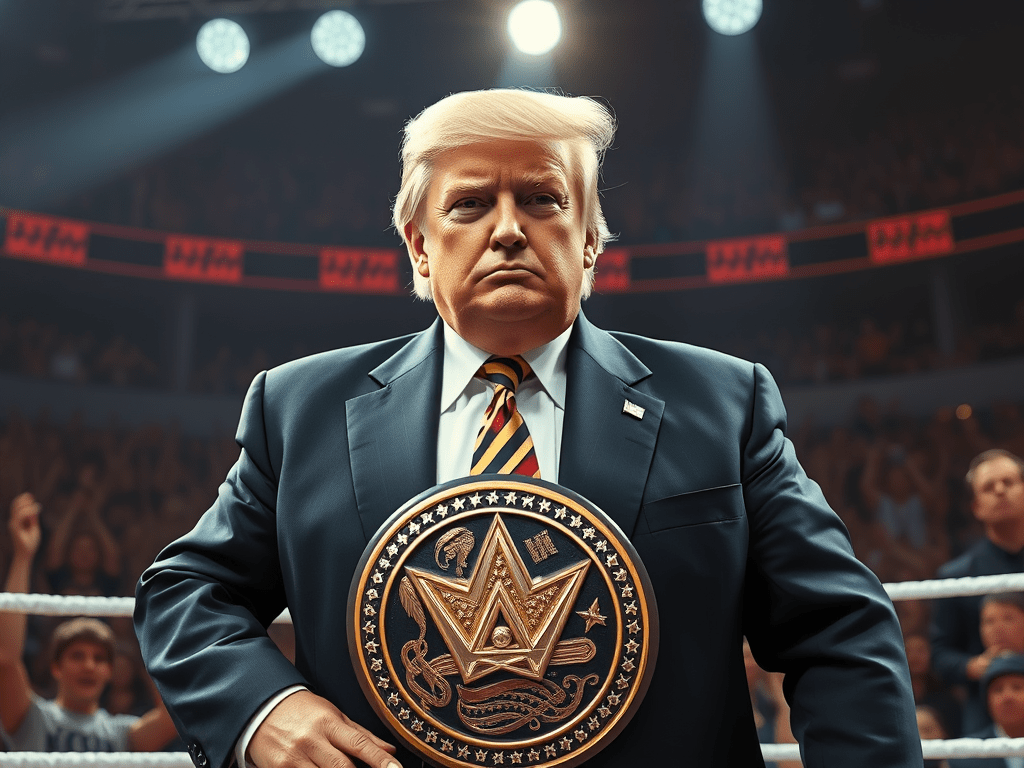
Kayfabe’s power has spilled beyond the wrestling ring and into the real world. In politics, kayfabe now reigns supreme. Like the best wrestling characters, political figures blur the lines between truth and performance, inviting us into a carefully crafted illusion. This isn’t about entertainment though; it’s about power. Vincent K. McMahon is arguably wrestling’s greatest promoter and kayfabe writer, but in politics, while there have been many kayfabe contenders, Donald J. Trump holds that undisputed title. Ironically, these two men once shared the squared- circle at WrestleMania 23 back in 2007—two kayfabe kings crafting a fiction for the sake of selling tickets.
Trump’s political career, especially since he lost the 2020 election, has been nothing but a kayfabe spectacle. His public persona crafts conspiracies to explain away any individual crime or loss. Trump’s theme music, Lee Greenwood’s “God Bless the U.S.A.” punctuates his character’s entrance to any stage, so he can spin his fiction to manipulate and maintain public perception, like Hogan. He’s not selling tickets for the WWE anymore; he’s selling the idea that America is in grave danger from “the enemy within,” something he said in a Fox News interview in October about Americans he doesn’t agree with. Trump thinks, along with his loyalists, he’s the only one who can vanquish said enemy. The kayfabe has many believing that Kamala Harris, Joe Biden, and Democratic Party (whose coined name is “the Radical Left”) are actual Marxist sympathizers, they have turned their backs on their country, and only Donald Trump, whose self-coined names are “a Patriot” or “a Real American,” can save us. The kayfabe is so strong that Haitians in Springfield, Ohio have received bomb threats due to the baseless claims Trump made about Haitians eating the dogs, cats, and pets during the one and only Presidential debate in September. The parallels to wrestling’s Golden Era playbook are uncanny. In ’91, Hulk Hogan “saved us” from Sgt. Slaughter and General Adnan— the enemy within. In ’24, Donald Trump wants to “save us” from Kamala Harris and the “Radical Left”— whom he calls “the enemy within.” This is a spectacle that has reasonable adults believing unreasonable things; things they aren’t remotely true or real, like Trump saying, “this country is finished” if Harris is elected. They know it’s fake. They don’t care. It fired them up and makes them feel. Trump has manufactured true believers.
Trump’s kayfabe extends far beyond mere wrestling theatrics, however. It is a deliberate strategy to blur the line between truth and fiction. He does this, in a large part, due to his social media website, Truth Social. It sells the illusion that whatever he and his fans post is, in fact, truth because, well, it’s in the name. Marrying the word “truth” with whatever one says or posts is classic kayfabe; it’s also classic propagandizing. It’s what wrester Ronnie Killings tried to do when he changed his character’s name to R-Truth. It allowed any claims he made to seem more “true” because they came from the self-appointed source of truth. Anyone who thinks truth comes from one human source, and a politician no less, has been bamboozled by the kayfabe. This is why Trump’s kayfabe is so dangerous. In wrestling, the illusion exists solely for entertainment, but in politics, the illusion operates within the halls of power. Trump’s illusions aren’t designed to entertain; they’re designed to deceive; they’re designed to draw heat. In wrestling, heat is the anger and emotion elicited from the audience by a wrestler’s actions. Heat often builds when a heel (a bad guy) unjustly beats the babyface (a good guy) by way of some heinous actions. Some of wrestling’s biggest heat came in July of 1997 when Hulk Hogan turned heel by attacking babyface Randy Savage. The political heat Trump evokes comes from villainizing whomever he is in opposition to. Trump presents himself as a babyface good guy akin to Abraham Lincoln and paints his opponents, specifically Kamala Harris, as “evil.” Trump’s commitment to the mechanics of the kayfabe requires there is a clear cut babyface and a clear cut heel. Heat sells. Heat sways votes, and Trump is selling the illusion he’s the babyface good guy and everyone opposed to him is an evil heel.
Kayfabe writers have been around long before Vince McMahon and Donald Trump. We used to call them showmen, snake oil salesmen, confidence men, and hucksters. Their audience was usually deceived because the pitch was so carefully crafted, mixing charisma, half-truths, and just enough plausibility to sell people. The illusion they created relied on the same tricks kayfabe does: an artful suspension of disbelief, a shared understanding between performer and audience, and a knack for storytelling that could blur the line between what is real and what is not. Hucksters aren’t just selling a product or an idea; they’re selling a narrative, a version of reality that felt real enough for people to buy into, even if somewhere in the back of their minds, they know it’s too good to be true. Audiences capitulate to the kayfabe because it feels good— like taking a long slow sip of wine after a long day— it’s intoxicating.
The problem with kayfabe intoxication is that it leads to a kayfabe kakistocracy. A kakistocracy is a system of governance run by the least qualified or most unscrupulous individuals. When combined with the principles of kayfabe, it becomes a political landscape defined by an illusion of competence, legitimacy, and authenticity. In a kayfabe kakistocracy, leaders project an image of strength, moral superiority, or competence, despite being corrupt or unqualified. Imagine if Hulksters (a name given to those who adore Hulk Hogan) elected Hogan as President simply because his pitch to “train, say your prayers, eat your vitamins; be true to yourself, true to your country; be a real American” was all he needed to earn the vote. More than likely, the outcome would be unfavorable. Performance leadership is not actual leadership. I loved the simplicity and patriotism of Hogan’s message as a kid, and I love it still, but I know it’s kayfabe candy for the masses. I used to teach a Leadership Seminar course using Stephen R. Covey’s The 7 Habits of Highly Effective People, and not once did I ever use Hogan’s pitch as content for the course. Voting Hulk-a-Mania into the Oval Office makes as much sense as voting Trump-a-mania into the Oval Office— both would end in a kayfabe kakistocracy.
I’m a Republican, so I enthusiastically voted for Trump 2016 and very hesitantly in 2020. Clearly, it took some time for me to learn he is not the man I thought he was, and I deeply regret ever supporting him and his lunacy. He is a contrived persona concerned only with ego and power. He’s the champion of the kayfabe kakistocracy. It’s why many of Trump’s own former cabinet and many White House officials, most of which are Republican, refuse to endorse him. They know he’s not fit for leadership; they’ve seen it first hand. It’s a damning character reference that reasonable voters should not ignore. Many do ignore it, though, because the spectacle of governance, where partisan performance takes precedence over actual leadership, is preferred. Governance has become entertainment, and the real issues are obscured by drama and histrionics. Trump’s kakistocracy, then, is one where appearances are valued over substance, and governance is reduced to oversimplifications and deceptive theatrics. JD Vance, Trump’s running mate, even admitted to such when he said,
Trump and Vance’s are creating a political system that is as entertaining as it is ineffective. It’s why Donald Trump can get away with false claims like: “Your kid goes to school and comes home a few days later with an operation. The school decides what’s going to happen with your child.” It’s why Trump’s followers follow suit, concocting their own kayfabe fiction. Together, Trump’s false claims and his supporters’ fabricated narratives create a kayfabe kakistocracy preparing for the main event.
Wrestling’s main event is Wrestlemania. America’s main event is the Presidential election. Unfortunately, when the main event has kayfabe characters like Trump and Vance perpetuating lies en masse, the heat builds and blinds. This constant kayfabe leads to the normalization of dysfunction, allowing Trump to say almost anything unhinged, asinine, or untrue. The real danger of Trump’s kayfabe kakistocracy, though, is that it invites chaos and confusion, undermining democracy itself. Trump’s lickspittles warn of democracy’s demise if Harris or the Democrats gain the White House, but our democracy’s most recent threats have literally come at the hands of Donald Trump and his faithful. January 6th was no “day of love” for the family and friends of the nine people who died that day due to Trump refusing to peacefully transition the Office of the Presidency. It was no “day of love” for anyone in America. It was the only the second time in American history there was an attempted coup at the US Capitol. The first time was during the War of 1812, when British forces invaded Washington, D.C.. Trump’s peddling of fiction leads to historical-level threats to our democracy.
The culture of chaos, confusion, and conspiracy that has resulted from Trump’s kayfabe kakistocracy has his most ardent supporters dismissing any criticism of Trump or his actions as “fake news.” They write off his most wild claims, like wanting his generals to be like Hitler’s generals, as either a jokes or harmless bravado, choosing instead to ignore any contradictions to avoid being forced to defend his personal attacks and indefensible grandstanding. This dedication to Trump’s kayfabe by his supporters resembles the unwavering loyalty of cults. Great examples of this dogmatic loyalty can be seen in satirical work of the Good Liars. This is all due Trump’s cult of personality–much like professional wrestling. Wrestlers amplify reality, perform stunts, and manipulate perception to sell the crowd on the illusion of a dramatic storyline. With wrestling, however, kayfabe has its limits. The audience eventually tires when the act becomes too exaggerated or repetitive, and the fiction ends when they disengage.
However, Trump’s political kayfabe has become more insidious, bleeding into the everyday reality of American politics and unraveling trust in shared truths. His weaponization of narrative and truth for personal gain has deeply impacted society, preying on the very fears he and his supporters project onto others. This denial, attack, and reversal—like a grappling move in the ring—has become his method to manipulate perception, fueling his followers’ fear of a dystopian America if his opposition wins. In an endless loop, he flips the criticism he faces onto others, evading accountability while keeping his base rallied and primed for the next round of the spectacle.
Puberty marked the end of wrestling’s enchantment over me. I couldn’t keep up the belief in the kayfabe; I could no longer buy into the fantasy. Wrestling’s most charismatic characters were entertaining, but the scripted nature of it all was too artificial. The drama came off as exaggerated, absurd. Likewise, my desire is for a shift in American maturity that will weaken Trump’s absurd hold over his loyalists—one that recognizes our nation’s challenges as too intricate to be addressed merely by branding opponents as “communists” and resorting to simplistic solutions. Donald J. Trump is no American hero, no savior of democracy, and hardly a decent human being. He’s a felon, a fraud, and, perhaps, one of the greatest writers of political kayfabe.
In September of this year, Netflix released a documentary, Mr. McMahon, about the life and legacy of Vince McMahon. Over the course of the six episodes, it becomes clear that Vince McMahon, the businessman and owner of WWE, becomes deeply entangled with his on-screen persona, Mr. McMahon, the egotistical boss he plays in the ring. This entanglement allowed for Vince McMahon to escape unscathed from decades of allegations of racism, steroid abuse, sexual assault, and sex trafficking— a scandal that has yet to reach its conclusion. The clever blending of McMahon the man with McMahon the kayfabe creation has undoubtedly allowed him to avoid accountability for his crimes and unethical behavior.
Donald Trump has done the same thing—blending his public persona with his real-life actions to blur the line between entertainment and reality. Just as McMahon crafted a character to captivate audiences while shielding himself from real consequences, Trump has shaped an image of himself as a fearless outsider, a self-made man standing up to a corrupt system. But this image is as scripted as any wrestling match. His claims of victimhood, outsider status, and moral crusade are just as fabricated as the Mr. McMahon character, designed to draw loyalty, distract from his flaws, and deflect accountability. While his followers see him as an anti-establishment champion, this crafted persona has allowed Trump to evade scrutiny and even thrive amid scandals that would have destroyed most public figures. Just as wrestling fans suspended disbelief for the drama in the ring, many have embraced Trump’s performance, accepting the narrative over the truth.
The question, then, is this: how do we wrestle truth away from the champion of the kayfabe kakistocracy? The answer is simple: with more truth. When Trump sells fiction, conspiracy, and lies under the guise of truth, the only antidote is actual truth. It was once said, “The truth is like a lion. You don’t have to defend it. Let it loose and it will defend itself.” Truth will win out because, for liars, the lies they tell will become the rope by which they hang. The more Trump speaks, the more he reveals himself as an autocrat and conman. Eventually he’ll say or do something that forces the more reasonable among his followers to see that Trump’s words and actions don’t align with the values they believe he represents—Christianity, democracy, and moral decency—and they never did. That’s when kayfabe’s enchantment will be broken and the GOP, which I have been a part of my whole life, can recalibrate it’s moral and political compass.
I’m reminded once again of Hulk Hogan’s theme music:
“I am a real American/ Fight for the rights of every man/ I am a real American/ Fight for what’s right/ Fight for your life!”
The message has always been clear: a real American “Fight[s] for the rights of every man,” not just the rights of those I agree with, not just those who align with my views, vote like me, or earn Trump’s approval. Ironically, Hogan endorsed Trump this year, a fitting case of kayfabe supporting kayfabe. Yet what both showmen fail to realize is that being a true American means standing up for the rights of all. Sadly, Trump shows us time and time again he considers a whole swath of Americans “the enemy within”— and that is the most un-American sentiment I have ever heard come from the twisted lips of former President. I hope the principled conscious of the American people will grab Donald Trump by ballot box, vote him out of the annuals of relevance, and bring that Machiavellian heel to heel.





 Shinnformation Station
Leave a comment