
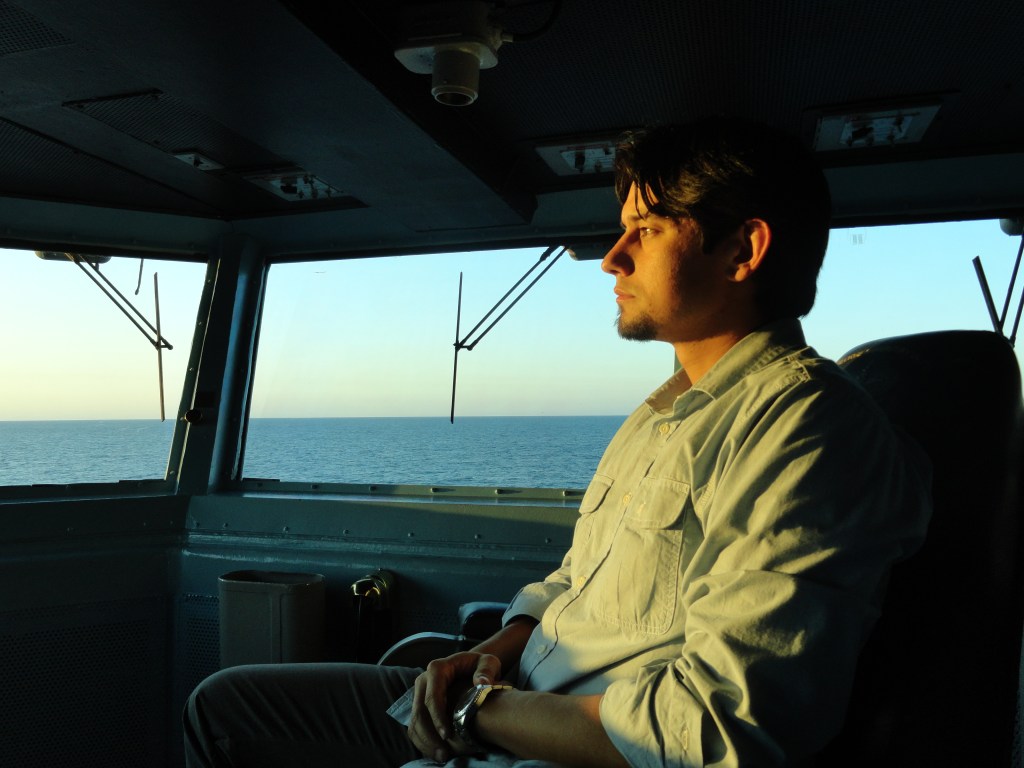
I originally wrote this for The Roadless Travel Blog on February 12, 2012. I was a full-time NC-PACE Instructor for the US Navy, and I spent the majority of my tenure with the Navy on the Pacific Fleet’s forward deployed aircraft carrier, the USS George Washington (CVN-73)— a ship I have come to think of as my steel-beach home away from home.
As an English instructor, I may not actually be in the United States Navy, but teaching college courses to the sailors aboard an air craft carrier affords me the opportunity to serve, in the form of education, those that serve our country. It also affords me the opportunity to live as if I were in the Navy: sleeping on a floating city in tiny quarters for months at a time; walking through a hanger by that seems determined to inflict injury with it’s chains, industrial machinery, and F-18 fighter jets; working in a dirty, noisy, militaristic environment; eating overly-preserved and often stale food with a bunch of pretentious pilots and overworked officers; speaking with soldiers about their tours in Iraq and Afghanistan, years of sea-duty, and anticipatory leave; mustering for man overboard drills at all hours of the day and night, standing at attention for the raising and lowering of the colors; requesting “permission to come aboard,” “permission to go ashore,” and that I don’t have to teach both the 0600 (6:00 A.M.) and the 2300 (11:00P.M.) classes for the next six weeks. My life on this ship is about as close to the Navy that one can get without actually signing one’s name on the dotted line. It is a unique experience, to say the least.
However, much of my time in the Quasi-Navy, or Snavy (Secret Navy) as one close friend of mine calls it, is spent Japan. I have over the past two years spent a few months here and a few months there on the U.S. Naval base in Yokosuka, Japan. It is where the U.S.S George Washington ports for the first half of the calendar year for its annual maintenance. Since I live on this ship, I also spend the first half of my calendar year in Yokosuka.
Life on a military base is interesting, and not just for the fact that everywhere I look there are men and women in uniform but for the fact that this is a place where time seems to stand still, or at the very least, continues on a much slower rotation than time elsewhere in the United States. The buildings are circa the 1950s: beige, three-story, concrete, and an institutionally cold and clean. The elementary school, high school, chapel, and baseball fields look as if they were from the set of a Leave it To Beaver or Dennis the Menace episode. In fact, many of the kids that play in these places of sepia tones maintain a playful yet respectful demeanor that is reminiscent of Beaver or Dennis. These kids are most certainly kids; they yell, they scream, but they, more often than not, come when they are called, and they know when it is time to “settle-down” without being told to “settle-down.” The streets are small, nearly everyone drives 35 miles per hour, and there are hundreds of bicycles, many of which aren’t tethered to a rider or a lock. The only signs of 2012 modernity are the Japanese vehicles that circle the streets, a Starbucks, and a few American eateries like Taco Bell, Chili’s, Subway, McDonalds, A&W Burger— but McDonalds and A&W seem to also speak of yesteryear 1950. Furthermore, The Gateway Inn looks like it could have been transplanted from Barstow, California along Route 66. And, what is probably the most nostalgic thing of all, the Benny Decker Theatre on base still has movies, hotdogs, and sodas all for $1.00 apiece. Without a doubt, spending $3.00 on a night out is nostalgia at its best.
I was born in 1982; therefore, I can only get my 1950s references from my parents, Hollywood, and the times as a kid I spent watching Leave it to Beaver and Dennis the Menace on Nickelodeon’s Nick at Night, but this base must be what America in the age of Harry S. Truman & Dwight D. Eisenhower must have felt like. Most everyone says, “hello,” “thank you,” “please,” “excuse me,” or “thank you for waiting.” There is something classically American here on this military base (and many of the many American military bases that I have been on around the world). I would, however, also venture to say that the military personnel and their families on this particular base also take some of their cultural cues from the surrounding Japanese who, as I have written about earlier, are quite courteous and composed. Whatever the underlying reasons, life on Yokosuka’s naval base is vintage good ol’ U.S.of A.
Unfortunately, all locations (metaphoric and literal), eras (ancient and modern), and ideologies (local and global) have fettered to their elements of good, elements of not-so-good. As a result, and in spite of my previous romanticizing its qualities, life on this military base in Yokosuka has its very obvious and almost obligatory faults. The largest imbedded fault of this base (and quite possibly of all the military bases I have been on) is this: most people here believe they don’t need and/or want anything other than which lies within the tiny boundaries of the base.
And, yes, I do see this as a fault, and a very capacious and crippling one at that.
Let me explain.
Many (but not all) who live on this base: military personnel, military families, contractors, and other Department of Defense personnel, for the most part, hold the notion that the world outside of these walls is not something worth venturing into, and not because they have “seen it all,” or “have no interest in Japanese culture”– that’s not it at all. Too many soldiers and sailors refuse to leave this sleepy little base because it is quite literally an isolated slice of America in a foreign country. Families forego going into Japan because all the convenient amenities for an American are here: everyone speaks English, one can pay in U.S. dollars, and this place requires no effort to engage with any culture that isn’t one’s own.
Again, I see this as a fault.
And it is not a fault rooted in simple convenience or national patriotism. Quite the contrary, it is a fault rooted in fear.
I mentioned earlier that life on this base is circa the 1950s; it is a “place where time seems to stand still, or at the very least, it continues on a much slower rotation than time elsewhere in the United States.” The ’50s may happily be remembered because of classic cars, The Ed Sullivan Show, and movies for a dollar (if not less). However, the ’50s are also unhappily remembered because of two of the predominant national ideologies of the time: McCarthyism (a.k.a. A fear of communist influence) and Plessy v. Ferguson’s lingering “separate but equal” (a.k.a. A fear of black influence and integration). As a result, ideologies such as these fettered the joy of a Rambler Hardtop (a classic car from the Nash Motor company) to the pain of the Little Rock Nine (a group of African-American students who were enrolled in Little Rock Central High School and needed to be escorted to school by the Arkansas National Guard for protection). Therefore, if one is to remember or try to revive the 1950s (by way of life on a military base or otherwise) one also inadvertently retrieves both the good and the bad.
Now, I bring up McCarthyism and Plessy v. Ferguson (which, admittedly, was overturned by Brown v. The Board of Education of Topeka in 1954) not to make a political statement, but a social one. Life on a military base circa the 1950s may look good on the surface, but much of the motif of ’50s ideologies seems to ring true still, albeit in a slightly different manner. I don’t see a Red Scare or a Black hatred boiling over on base, but I do see much of the same fear of the 50s here. In Japan, the American is the foreigner, the outsider, the Other (Edward Said). And Americans do not like being the foreigner, the outsider, or the Other. The standard operating procedure– blatant military lingo– is for the U.S. to enter, not to be entered upon. But for soldiers and sailors to leave this base and enter Japan isn’t an act of entering upon (Americans going in and upon the Japanese). On the contrary, it is an act of being entered upon (the Japanese coming onto and around the Americans)– and a fear of this being entered upon is ultimately why many do not leave this base.
There is a an initial loss of personal power when one enters or encounters another community or culture. To be forced to speak another language, eat another food, or think though different social norms is admittedly uncomfortable and places one in a place of personal vulnerability. I feel it every time I ride the train, attempt to ask in Japanese where the restroom is, or try to order food on a Japanese menu that doesn’t have pictures. However, that place of uncomfortability and vulnerability is a catalyst for personal growth. For when one overcomes the fear and frustration of being entered upon by another way of being, one realizes that loss is not result, but gain. After all, both Italian theorist, Antonio Gramsci, and modern Literary scholar, James Paul Gee spoke to the notion of breaking out of the hegemony (Gramsci) or one’s “primary discourse” (Gee) for the sake of acquiring a secondary “discourse” or alternative systems of thinking. And this was not for the sake of abandoning one’s original system of thinking, but for the sake of understanding one’s original system (or self) better. Linguists (and most linguist laymen) will tell about the phenomenon that is better understanding of one’s primary language once one learns a second and /or third language. The same goes for ideology, culture, and community. People rarely abandon their primary ways of being in the world as a result of exposure to other ideologies, communities, and cultures. Thus, the fears of the soldiers and sailors on this naval base seem as misguided and nearsighted as the fear-filled ideologies of the 1950s.
At this point, I suppose I should enter a bit of a disclaimer. I to not want to fully equate the personal sequestering of the military personnel on this base with the social segregation of the pre-Civil Rights era. But I do want to make solid the comparison between the fear that held America back in the 1950s and the fear that holds Americans back right here and now in modern Japan. In the classes that I teach, I try to impart to my students that they should consider breaking out of the quagmire of comfortability and monotony that is McDonalds and their point-and-pick menus. I implore them to brave the Japanese trains, chart the Japanese menus, and for all that is good, get mixed into the “contact zone” (Mary Louise Pratt) that is a silly American Gaijin (the Japanese word for “non-Japanese” or “alien”) entering, and ultimately being entered upon by, another culture and community.
Lastly, and not to get too high-up on a digital soap-box, but the idea of interacting with another communities or cultures is something that I would implore all individuals who let the fear of going outside the wall of their personal fortifications to do. I say this only because I have far too many friends and family that I constantly hear say things like: “I would love to travel,” or “I have always wanted to learn to play an instrument,” or “ I have always wanted to learn a different language,” or “I should go back to [fill in the blank], or “I have always wanted to [fill in the blank],” or “One day I will [fill in yet another dream-soaked blank], but ultimately, they don’t. They don’t. It may be one-part pragmatics (due to money, circumstance, or otherwise), but it almost always seems to also be one-part fear.
My Quasi-Navy life affords me the chance to interact with some fascinating communities and cultures, and for it I am very grateful. However, it has also afforded me to see what life looks like when people choose not to interact with other communities and cultures, and it looks something like life, circa 1952.




 Shinnformation Station
Leave a comment